
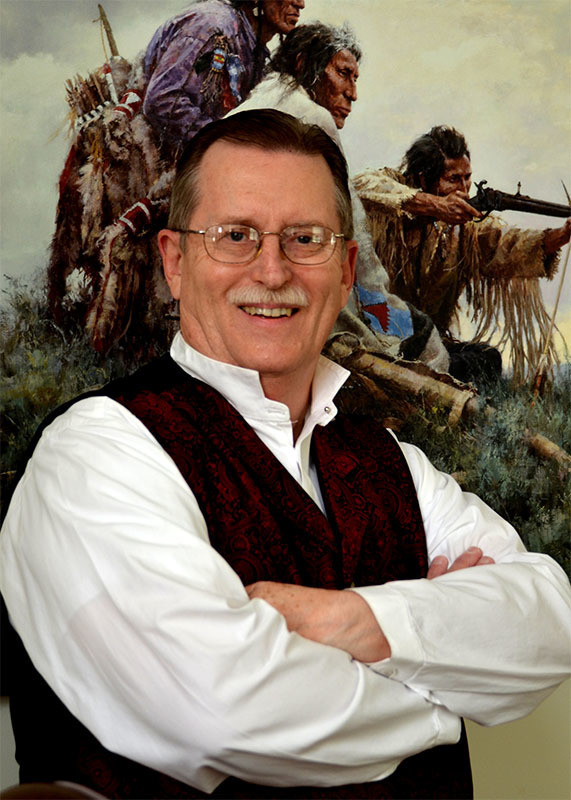
Q. Did you have to do a lot of research before writing the story? With all the information out there, how did you decide on a time period?
A: Yes, I did a lot of research and have a large collection of histories on Geronimo but relatively few on Chato. Many of the information nuggets on Chato come from Geronimo’s histories and a few from people who knew Chato personally. I wrote two novels about the life of Geronimo. The first, The Iliad of Geronimo, covered his ten years of war and peace before he surrendered to General Nelson A. Miles in September 1886. The second novel was The Odyssey of Geronimo, which covered the years he was a prisoner of war until he died. Chato’s story so closely paralleled that of Geronimo that some historians have called him Geronimo’s doppelganger––his shadow. It was only natural to cover the same time periods in Chato’s life where he went from Geronimo’s chief lieutenant in raiding and war to one who Geronimo called a traitor and liar (totally untrue), which is the story in Desperate Warrior. Volume Two of the Chato story, Proud Outcast, covers the years Chato was a prisoner of war at nearly all the same places as Geronimo and then lived the rest of his life on the Mescalero Reservation as a recluse shunned by his own people.
Q. Do you think you will write another story about Apache Warriors?
A: I have a two-volume story on Apache Kid, The Chronicles of Apache Kid. Volume One is: Army Scout, which will be published by Roan & Weatherford in 2025 and Volume Two is: Vanished Outlaw, which is scheduled for publication in 2026. Kid is a fascinating character who went from one of the Army’s best Apache scouts to one of the most feared southwest outlaws and then suddenly vanished. I’m now writing a story that uses Yellow Boy characters (a trilogy on the Mescalero Apaches) and Chronicles of Apache Kid characters to explore what happened to the Apaches in Mexico who seem to have vanished in the 1930s.
Q. Was it hard to keep track of the storyline? Did you have an outline as to how it all comes together?
A: There is an old saying about historical events: You can’t make this stuff up. I tried to do a detailed outline for my first novels and found history and the lives of the characters kept overriding the outline. Once I’ve done the research, the historical story and cultural artifacts are a bright line in my mind that’s easy to follow in creating the novel’s storyline. In the spaces where the history is unknown, I try to create action scenes that are consistent with the personalities and times consistent with the emotional arc of the story.
Q. There are several secondary characters which you did a great job creating, how did you come up with those?
A: If one looks closely at the history of the main characters, lots of little nuggets of information will be found that help paint the personalities and their reactions of those around the main characters. Mix that information in with their culture and I think a clear picture of the secondary characters forms that helps create their place and potential actions in the story.
Q. How do you maintain creativity and avoid mixing up the storylines?
A: The Spanish-American philosopher George Santayana once said, “History is a pack of lies about events that never happened written by people who were never there.” He also said, “Those who cannot remember the past are doomed to repeat it.” What Santayana said about history, I think is true about novels. I think history is not a sharp black line through time, but a broad gray one that allows some creativity to explore the historical truth. I let the history carry the storyline. The creativity comes in imaging how the characters see and understand what happens to them by reading between the lines of the historical record. Remembering the uniqueness and timeline of the individual for whom the story is about makes it easy to avoid mixing up storylines.
General Questions
Q. Many authors have unique writing rituals or habits. Could you describe your writing process? How do you get into the right mindset to bring your stories to life?
A: To begin a story, I’ll mentally identified its emotional arc and identified or developed an initial event to give the reader some idea of the main character’s personality and view of the world as seen through his eyes. I try to write every day even if it’s just a two or three hundred words. When I begin a writing day, I read through what I’ve written the previous day, make corrections and do rewrites of awkward sentences and paragraphs, by then I’m in the groove to carry the story forward. I think an author is much like an actor. A good method actor assumes and projects the personality and emotions of the character he’s portraying. That’s what I try to do with the characters about whom I write (it’s also why I write in first person POV). All those reading-between-the-lines nuggets in the research about how a person acts and thinks is what helps bring the character to life by imaging how they would see and react to a scene. I also read classic novels, a little every day, to learn how the best tell their stories.
Q. Writing styles can evolve over time. How do you think your writing has changed or developed since your first novel, and what lessons have you learned along the way?
A: I come from a physical science background where it was normal to write in a passive voice and include any relevant details. In the draft of my first novel, I had to discipline myself to write in active voice, to show a scene rather than tell, and not to editorialize to tell the reader what to think. I had to learn to trust the reader. Those things are hard to learn and require page-to-page focus. My first editor, who taught me a lot, was always telling me to “cut to the chase and don’t bore your readers”. Reading the little book about writing by Elmore Leonard said the same thing and was a revelation. His ten commandments on writing and my first editor helped me get a more active voice than when I first started. There is also the writer’s creative voice. In my early work I had an editor tell me I hadn’t found my voice and to keep trying. I found my voice when I finally realized that what I really wanted to write about were First Nations peoples in the southwest rather than ranch wars, and that was after four ranch war novels. I think authors find their voices when they finally realize what they most enjoy writing about and dedicate themselves to telling a good story.
Q. Writing a novel requires consistency and dedication. What keeps you motivated to stay on track with your writing goals, especially during challenging moments?
A: Oakley Hall, one of the great American novelists of the twentieth century once wrote, “The pursuit of truth, not the facts, is the business of fiction.” My motivation for staying on track is finding a story that I know is mostly historical facts but has a mystery or big question to it. Then in my writing discovering the truth to that mystery beyond what the facts alone rarely, if ever, reveal. The thrill of discovery through my writing to learn why true characters acted they did is what keeps me digging and scratching at a story’s surface through what time and history have hidden.
Q. What advice can you give upcoming writers when they start to doubt themselves and their abilities. What strategies do you use to keep the momentum and creative flow moving?
A: Upcoming writers need to understand for whom and why they write. The first person they must satisfy is themselves. Then they need to realize that the clear expression of thoughts and ideas to a world of different backgrounds and understandings is a hard but eminently satisfying climb over a mountain trail filled with subtleties requiring study of the masters of their craft and writing every day. A year before he was elected President, Jimmy Carter wrote a book, Why Not the Best?. I think writers on their journeys need to answer Carter’s question everyday about their own work before they let something slip-shod pass that they think they, or an editor, will correct later. If writers are giving their best to what they have written, then there can be no room for doubt about their work, only improvement. A writing journey is a learning journey. Don’t be afraid to make a mistake or leave large parts of your manuscript on the cutting room floor and do the best writing you can every day. I keep the momentum and creative flow moving by reading masters like Larry McMurtry, Thomas Mann, Faulkner, Steinbeck, and Hemingway. I’m always researching in the history of the times for characters and scenes that might make a good story. I experiment with my writing to create scenes that solve plot knots, use different points of view, or try to think how it would be shown in a movie. The key thing is not to avoid experimenting with your work and to learn what that experiment shows you
 My Book Addiction and More
Leave a comment